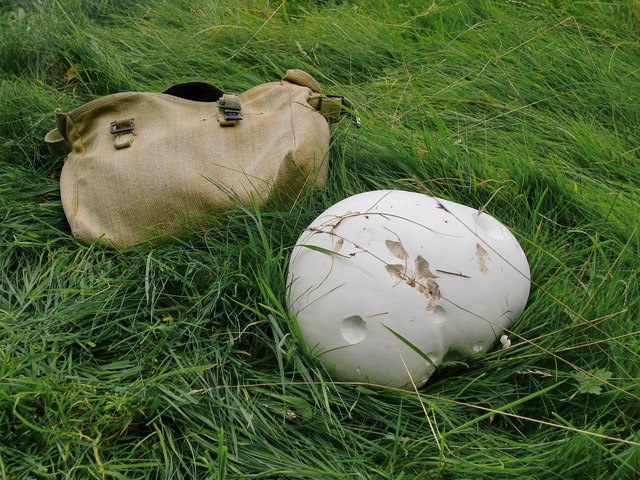
Have you ever been out on a walk or a hike and found a gigantic white orb growing from the ground amongst the greenery? If so, you’ve probably seen an edible giant puffball mushroom!
Now, before you pick it up and start eating, let’s learn how to identify a giant puffball correctly!
When and Where:
Giant puffball mushrooms are a treat that pops up in the late summer/early fall. They are usually found in
- Grassy fields
- Meadows
- Along the edges of the forest
- Across North America and Europe, mostly
- Mid-August through September
Mushrooms need humidity to thrive, so giant puffball mushrooms are generally found in areas with ample sunlight and moisture.
Look for giant white orbs peeking through the grass—they’re often hiding in plain sight!
Size and Shape:
Giant puffball mushrooms are called “giant” for a good reason. When you’re foraging for edible mushrooms, bigger doesn’t always mean better. Mushrooms continue to grow as they age, which means gigantic mushrooms may be past their prime for consumption. A healthy, young puffball will be
- Round or oval-shaped
- Smooth white outside
- Spongy, slightly firm, solid white inside
- As small as a baseball
- Up to as big as a basketball!
Puffball mushrooms don’t have stems or gills–they grow like a ball straight out of the ground with a root-like attachment on the bottom.
If you find a mushroom resembling a puffball but has a stem, it is likely a young Deathcap (Amanita phalloides), which is a toxic lookalike.
The Touch Test:
The touch test is an essential tool in mushroom identification. Edible giant puffballs will be
- Firm and smooth on the outside
- Have “tight” skin, meaning no dents or wrinkles
- No soft spots, holes, dents, or discoloration
- Completely white in color
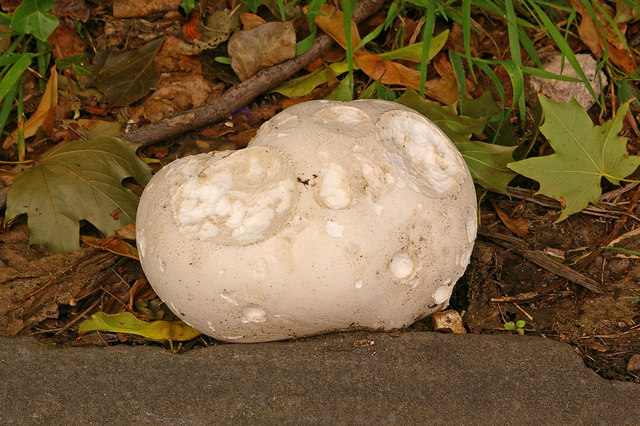
If you notice cracks in the mushroom, the slice test and interior color will be essential to verify whether it is still edible. When the puffball mushroom begins to crack, it has already started releasing spores and may no longer be suitable for eating.
Always check for soft spots, discoloration, animal bite marks, and other odd blemishes, as they may signify a spoiled or decaying mushroom.
The Slice Test:
Now that you’ve checked all the boxes for the outer identification, it’s time for the moment of truth: the slice test. Slice the mushroom open to check the interior; the inside should be
- Solid white all the way through
- Free of gills, holes, or a stem
- Slightly firm and spongy (marshmallow texture)
Remember that any discoloration (yellow and brown specifically) inside the mushroom could mean it is too old and already releasing spores or decaying.
If the color inside the mushroom turns purple or black, it is probably an Earthball (Scleroderma species), a toxic lookalike to the puffball mushroom.
The Spore Print Test:
Another identifying factor that adds an extra layer of certainty is spore printing. Every mushroom spore print is different, so it’s essential to research what it should look like based on the mushroom species you are identifying. Here’s how to conduct a spore print test:
- Cut your mushroom in half
- Place it open-side down on a piece of white paper or glass
- Cover it with a container and let it sit overnight
- Reference a reliable field guide comparing the color left on the paper or glass
- Puffball spore prints will be a brown/green color
The color left on the glass or paper in the morning will tell you more about the species of mushroom you have! Puffball mushrooms should leave a greenish/brown spore print.
My Advice:
While foraging for mushrooms is an exciting adventure, it is crucial to prioritize safety. Seek guidance from experienced foragers and mycologists and reference reliable field guides to ensure proper identification. If you are ever unsure of any mushroom identification, throw it away. It’s never worth the risk of harming yourself or others if you aren’t positive that what you’ve found is safe for consumption.
Look for local foraging groups in your area, and join foraging communities online to help expand your knowledge base and access to experienced individuals in this field.
You can learn more about foraging mushrooms in my other post– Mushrooms: Best Tips and Methods for Foraging!
All in all, foraging is such a rewarding hobby that I encourage everyone to try their hand at it. Learning more about the world around us will help you to build self-sustainability, knowledge, and confidence. Plus, a little bit of sunshine and a brisk walk never hurt anybody!
Thanks for reading, and happy foraging!
-Jessica Chaidez
 Bigfoot's Friend
Leave a comment